
Bats in the Attic 2026: Goths, Gulls & Grooves.
Alhambra Live, Morecambe — 18–19 September 2026
I’m a simple soul so I’ll be honest: ‘Bats’ 2026 had me before the first band even entered stage left. For many Morecambe itself will spark memories of childhood holidays by the sea and with ‘The Alhambra’ as the venue, the stormy seas & grey skies outside it always makes it feel like a wonderfully odd but always spiritually rewarding dual pilgrimage to worship at both the church of Gothic Rock n Roll & Mother Nature herself: The gathered crowd more like a loving congregation of the beautifully afflicted than a paying audience.
It’s the music I love with the people I love. That might not be much to some but for me & I’m pretty sure for many who were there, it’s more than just a ‘festival’. More than just a weekend off work. It’s a nexus point, a gathering of darkly inclined souls coming together in love; love of the music, love of the scene & a love of each other. It’s connection. That might sound trite or even a little naive but I think it’s true, especially in the increasingly dystopian world we find ourselves in, full of hate, ignorance, fear & division. Being in a place where love, tolerance & acceptance are the prevailing feelings, it becomes more than just a refreshing ‘weekend break’ it becomes a lifesaving necessity.
The Festival returned for this year’s 5th instalment with the confidence of one that knows exactly what it is: intimate, international in its musical scope & genuinely & lovingly curated by everyone involved from – Alex & Fiona Wetton who run the Venue. ‘Bats In The Attic’ organisers Mike & Donna McLeod. Tim Jarvis on the merch stall to promoters & punters, to bar staff & the bands themselves make it feel as much like an extended family gathering as an actual music festival.
Much like it’s older & similar siblings in terms of feel – ‘Darker Days’ in Leicester & ‘Corrosion’ also at The Alhambra – ‘Bats In The Attic’ is much less the commercial weekender type of certain jaded Goth festivals and more like a gathering of people who have travelled specifically to see each other as much as the music. Black-clad clusters along the promenade, with familiar faces greeting one another with warm smiles and patchouli scented hugs.
There’s something pleasingly old-fashioned about committing to a weekend like this. Not a festival built around algorithmic hype or massive headliners (though kudos where kudos is due for pulling off the Saturday headliner) but one where the pull is more instinctive: a venue, a scene, a few names you trust, a few you only half-know, and the promise that if you give yourself over to it, you’ll find your new musical beau to take home. That’s the kind of festival experience I value most these days & why ‘BITA’ is my favourite. I want the sense of entering a room and gradually realising that the whole weekend has its own temperature, its own rhythm, its own set of private rules. ‘Bats in the Attic’ has that in spades.
There’s also something properly pleasing about a gothic festival taking over an old seaside theatre. The salt air outside, the old-world drama of the inside, and the sense that everyone has arrived not just to watch the bands, but to step into a shared but private little world for the weekend, All of which feeds into each other beautifully. Morecambe gives the event a faded-coastal charm, while the Alhambra’s indoor setting keeps everything close, warm and immersive. I have a lot of time for small festivals that know their own shape, and ‘Bats in the Attic’ like ‘Corrosion’ & ‘Darker Days’ works because it never tries to be something it’s not. The venue’s enclosed feel makes each set seem immediate: drum machines reverberating through the room, basslines settling into the floor, and lighting that gives even the quieter performances a cinematic edge. Between sets, the festival never loses momentum; conversation, DJ selections, and the movement of people through the venue keep that atmosphere alive without ever making it feel crowded, faceless or impersonal.
What makes the setting especially effective is the contrast between outside and inside. Outside, Morecambe offers the greys, the wind and the open spaces of the coast; inside, everything narrows into deep colours, heavy rhythms and familiar gothic silhouettes. I love that little shift. It gives the weekend a sense of transition, as if crossing the venue threshold means leaving the ordinary town behind for a more theatrical, nocturnal version of it. You could step out for air, remember that the real world was still out there, then step back in and be swallowed again by bass, smoke, leather, lace, dry ice and that comforting gloom we all pretend is misery but secretly know is joy.
The pacing helps as well. Some festivals exhaust you by lunchtime, as if volume and busyness are the only ways to prove value. ‘Bats’ is more deliberate. There’s time to listen, time to drift, time to stand with a drink and watch the room rearrange itself between sets. I & I’m sure 99% of the other parishioners present enjoy the in-between moments nearly as much as the performances: the low murmur while gear is being changed over, the little pockets of conversation forming and dissolving. Those details are easy to overlook, but they are often what make a festival feel lived in rather than simply scheduled. Something that ‘McGothic Fox’ promotions understand. They live it as much as we do.
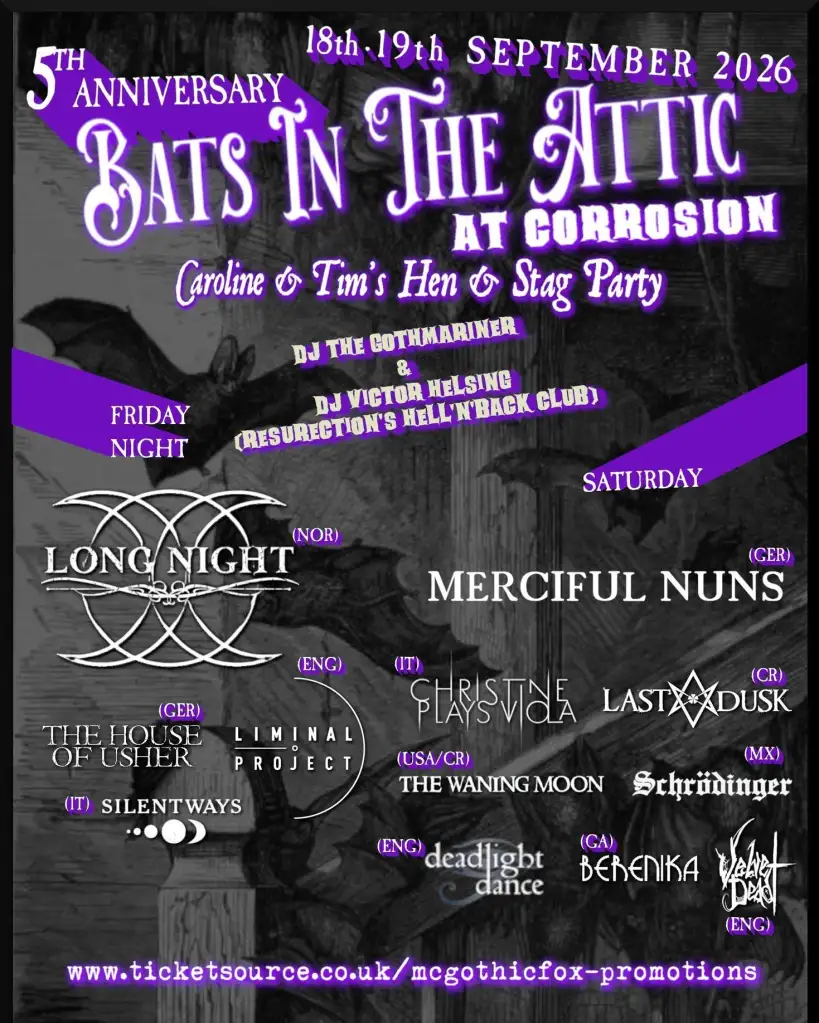
Friday’s bill leaned into elegant melancholy and classic gothic textures, with ‘Long Night ‘bringing a melodic Norwegian gloom to the headline slot and ‘The House of Usher ‘adding the weight of long-standing German gothic rock tradition. ‘Liminal Project’ and ‘Silentways ‘widened the palette, pulling the room towards more cinematic Darkwave and rhythm-driven Post-Punk moods. For me, the first night had the feeling of being slowly reeled in rather than grabbed by the throat. It was not explosive all at once, and it did not need to be. The best moments were those where melody and atmosphere locked together and the darker material became expansive rather than merely bleak. That’s the sweet spot for this kind of music: not just gloom for gloom’s sake, but songs that make the shadows feel strangely generous.
Friday night settled in with a kind of patience, letting the mood gather in layers. There were moments where the room seemed to lean forward together, not in a dramatic festival-crowd way, but with that quiet concentration you get when people are properly listening. For music that so often thrives on restraint, repetition and atmosphere, that attention matters. It meant the subtler material didn’t get lost, and the more forceful passages land with far more weight.
‘Long Night’ were the point where Friday really seemed to darken around the edges. Their melancholic, melodic goth rock suited the Alhambra almost too well: the songs moved with a slow-burning confidence, bass and guitar lines curling through the room like smoke while the vocals gave everything that grave romantic pull. It was not a set that needed to batter its way into memory. It glowed there instead, steady and cold, making the venue feel smaller, closer, and more enclosed with every song. ‘The House of Usher’ offered a different kind of shadow — older, heavier, more cathedral-like — bringing a European Gothic Rock weight that felt textured, assured, and steeped in weathered grandeur without ever tipping into museum-piece reverence. Between them, ‘Liminal Project’ and ‘Silentways’ gave Friday its shape: ‘Liminal Project’ seemed to fill the air with widescreen darkwave mist, while ‘Silentways’ brought a leaner Post-Punk tension, the kind that keeps the body moving even when the mood is turning inward.
Saturday was broader and heavier, crowned by Merciful Nuns, whose first UK appearance gave the second night its sense of occasion. Around them, Christine Plays Viola, Last Dusk, The Waning Moon, Schrödinger, Deadlight Dance, Berenika and Velvet Dead helped turn the day into a survey of the contemporary goth underground: European, Latin American, British, synth-led, guitar-led, polished, raw, and always atmospheric. If Friday established the mood, Saturday’s line up expanded it, and that suited me down to the ground. I love when a festival reminds you that goth is not one fixed sound preserved in aspic, but a whole sprawling, argumentative, romantic, noisy family of sounds. Some sets pushed towards ritualistic intensity, others leaned into Coldwave precision or post-punk urgency, but the programming held together because every act seemed to understand the emotional architecture of the weekend.
By Saturday, I felt the weekend had properly opened up. There is a particular pleasure in reaching the second day of a small festival and realising that the room already has its own shared history. People know where they like to stand or sit, which faces they have started recognising, which conversations can be picked up again later. The music benefited from that. Bigger, heavier or stranger sets felt less like isolated performances and more like chapters in something the audience had already agreed to follow. That sense of continuity gave the day an extra charge.
On Saturday, Merciful Nuns were the obvious centre of gravity: the point where the whole weekend’s atmosphere gathered itself and became heavier. Just the idea of their first UK appearance gave the room that little extra charge you can feel before a band even begins, a low flicker of expectation passing through the crowd. They arrived with smoke, perfectly precise beams of light & a sound that seemed to widen the space rather than simply fill it — deep, ritualistic, cavernous, and full of that devotional darkness that makes gothic rock feel less like entertainment and more like ceremony. Not a set but a sermon. Not just a band performing but performance art in its truest sense. As a longtime fan since their ‘Garden of Delight’ days finally getting to see Jawa & Artaud Seth perform their deeply symbolic, spiritual & frankly outstanding set only mere feet from my en-rapt face, it was & is a musical memory I’ll treasure forever. ‘Christine Plays Viola’ stood out in a different register, all poise and controlled voltage, folding gothic rock, darkwave and post-punk into something sleek without sanding away the unease. ‘Last Dusk’ brought a distinctive Costa Rican presence that felt humid, dramatic and urgent, cutting through the bill with a pulse of its own & made even more memorable when members of the UK favourite grass roots acts ‘The Glasshouse Museum’ took to the stage in their very own Goth supergroup moment. ‘The Waning Moon’s’ synth-driven soundscapes opened up colder, more spectral spaces, as if the room had suddenly gained a night sky. Around them, ‘Schrödinger’, ‘Deadlight Dance’, ‘Berenika’ and opener ‘Velvet Dead’ carried the international edges of the line-up beautifully. Flashes of South American darkwave tension, Eastern European atmosphere, and classic UK goth energy that made Saturday feel like a living map of the scene rather than just a parade of familiar references.
A few of the songs associated with the line-up also helped explain why certain performances lingered in the head afterwards. Long Night’s “Sorrow Returns” seemed to carry exactly the kind of dusk-lit ache the weekend was built for, while ‘The House of Usher’s’ “Equinoxe” suggested something older and more ceremonial, all stone corridors and slow-moving drama. ‘Last Dusk’s’ “Evocation” had the feeling of a spell being worked in real time, ‘Christine Plays Viola’s’ “At Last, I Found You” brought a sleeker, more haunted urgency, and ‘Merciful Nuns’ “Demons” felt like the sort of title that almost explains itself before a note is played. What mattered was not just that these songs offered highlights, but that each one opened a slightly different door into the same shadowed building: melody, ritual, drama, propulsion and release. A festival like this can easily become a single shade of black if the programming is lazy, but here the standout moments had their own colours — bruised purple, cold blue, candlelit gold — even if all of them were drawn from the same nocturnal palette.
The appeal of the line-up was not simply in the names at the top of the bill, but in the way the running order encouraged discovery. For a festival of this size, there’s always a pleasing lack of filler. Even the lesser-known acts had room to establish a distinct identity, and the audience responded with the kind of attention that can make a small venue feel unusually generous. That matters to me. I would rather have a weekend where I come away with one new band under my skin than a giant festival where half the day disappears into queues, clashes and background noise. Bats in the Attic gives the bands room to breathe, and because of that the weekend built up a cumulative force rather than just a list of isolated sets.
The festival’s focus on community, discovery and authentic trad goth culture shines through clearly, and this is where ‘Bats in the Attic’ really wins me & everyone present over. It’s not an event that tries to flatten goth into a quick cash grab of nostalgia & costume. Its strength lies in treating our beloved niche little scene as very much alive & is doing a damn good job at keeping it so: new bands alongside established names, international acts beside UK artists, DJs keeping the pulse moving between & after sets, of which special mention has to be made to DJ Victor Helsing who’s musical knowledge & curation of said knowledge with unconventional floor fillers were the reason I stayed up way to late & still have sore calf muscles. There was a welcoming thoughtful seriousness to it whilst still getting everyone up to dance, which is a hard balance to get right.
The whole event is organised & populated by people who care about the music, the history and the look of the scene, but the atmosphere never feels cold or exclusionary. There’s no online gatekeepery bullshit here, only…yes it’s that word again… love. ‘Bats in The Attic’ & Alhambra Live are a living celebration of a culture that survives because the people that love it continue to organise it, show up for it, support it, argue about it, dance badly to it, buy the shirts, follow the bands and pass it on.
That sense of care was visible in all the small things: From the fact that organisers Donna & Mike speak to, I’m pretty sure, everyone in attendance even if it’s just a quick hello & acknowledgement of presence to the free sweeties on every table or the super helpful & friendly bar & security staff. It’s the way conversations started between strangers over band shirts or makeup, the patience between sets, the enthusiasm for acts who had travelled a long way, and the feeling that the weekend belonged equally to performers, organisers, DJs and audience alike. I have always liked the fact that goth, for all its dramatic cheekbones and romantic gloom, can be one of the warmest scenes when its allowed to be itself. ‘Bats in the Attic’ doesn’t need spectacle to generate character. Its character comes from a shared understanding of atmosphere, from the trust placed in the curation by Mike & Donna, and from the pleasure of being in a room where the music doesn’t have to explain itself to anyone because we love it.
I think that warmth is one of the things outsiders often miss about scenes like ours. From a distance, goth can look severe, mannered or intimidating. Up close, at its best, it is full of generosity: people recommending bands, comparing old gigs, complimenting outfits, helping one another find merch tables, laughing at the absurdity of being this committed to darkness while still being delighted by it. ‘Bats in the Attic’ captures that contradiction beautifully. It takes the music seriously & treats both artists & audience alike with genuine…dare I say it again… love. All without ever taking itself ‘too’ seriously, and that makes the whole weekend feel more human. Something that’s been lost in bigger, more commercial festivals.
If I had to explain the appeal to friends outside the scene, I would start there rather than with genre labels. Yes, it was Goth rock, Darkwave and Post-Punk. Yes, the guitars chimed, the basslines prowled, the synths glowed coldly and the vocals often sounded as though they had wandered in from a ruined chapel. But the real appeal was the feeling of being among people who understand why that matters. Not ironically, not nostalgically, but sincerely. That sincerity gives the weekend its emotional weight.
‘Bats in the Attic’ is less like a conventional festival and more like a carefully tended meeting point: part gig weekend, part reunion, part discovery chamber. Its appeal lies in the details — the boutique scale, the seaside setting, the shadowy sweep of the music, and the feeling that everyone in the room understands why these sounds still matter. What I love most is its balance: reverent without being trapped in the past, niche without feeling closed off, and atmospheric without becoming one-note. It offered the pleasure of recognition for us auld goths while still leaving space for surprise, which is exactly where a small specialist festival can thrive.
For anyone drawn to Gothic Rock, Post-Punk and Darkwave, it offered what the best small festivals should: atmosphere, belonging, and the possibility of leaving with a new favourite band & even more new friends. More than anything, it reminded me why these events matter. Not because they are slick, huge or fashionable, but because they create a temporary little world where the strange, the gloomy, the romantic and the noisy all feel completely at home. I left thinking less about individual highlights than about the mood the whole thing had built: a weekend-sized spell cast upon all who entered. Modest in scale but lingering in the system long after the final song fades & the last pointy boot reluctantly leaves the dance floor.
With Friends, in a dark room by the sea, with the bass still ringing in my ears it felt like more than enough & I can’t wait to do it all again next year. See you there.
Lebs Fiasco.